
Sep 27, 2026News & Insights
Ultimate Guide to Tin Box Types
Explore types of tin boxes by shape, lid, construction and application. Learn how to choose custom tin packaging for food, tea, coffee, candles, gifts and cosmetics.
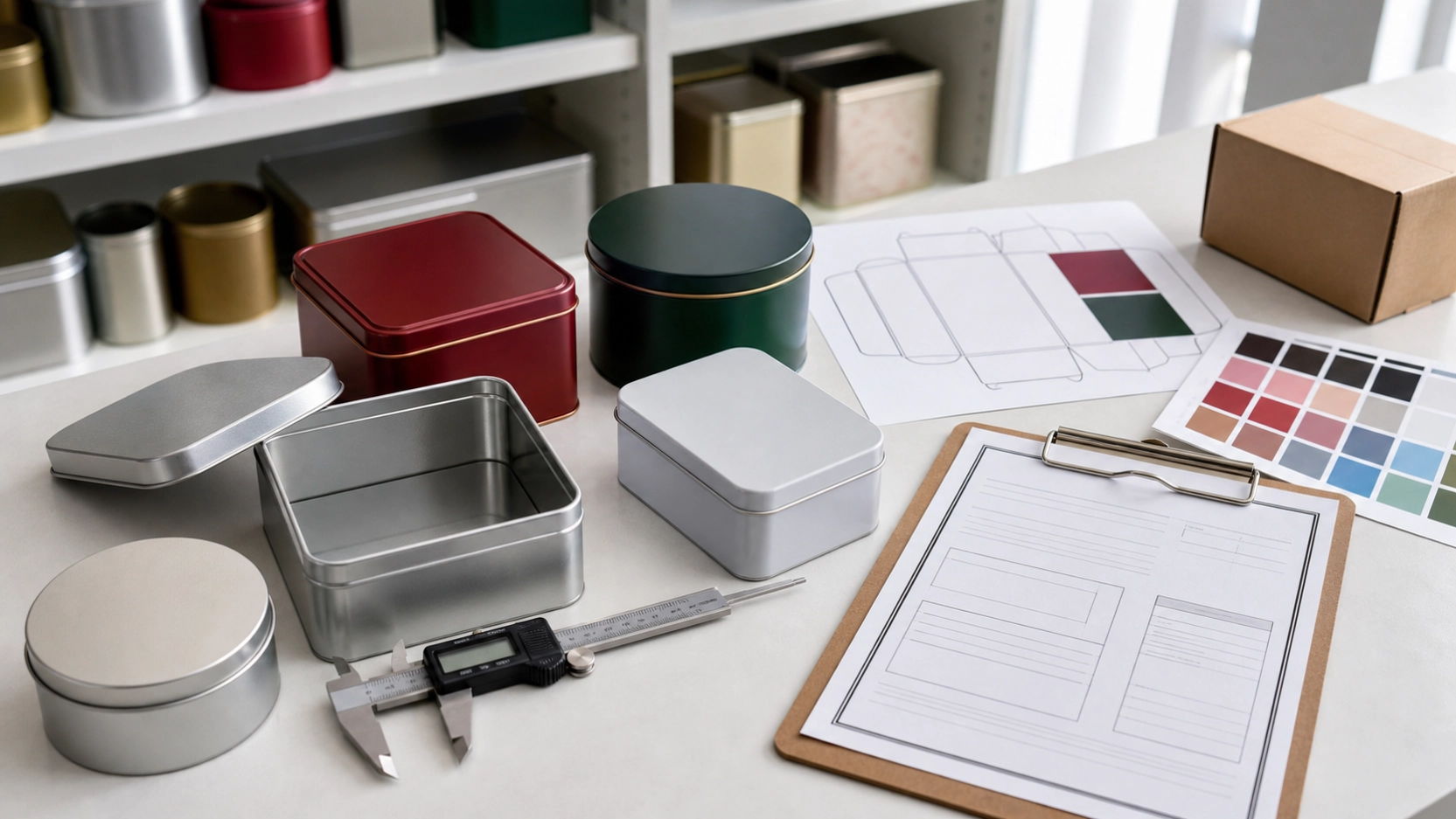
A tin box can look correct in a product rendering and still fail during packing. Cookies may have too much movement inside the container. A tea tin may close neatly but provide less moisture control than the product requires. A decorative lid may distort when a large embossed area is formed. Rectangular tins may fit the shelf well yet waste carton space if the dimensions were selected without a shipping plan.
For packaging buyers, the useful question is not simply, “What types of tin boxes are available?” You need to know which tin construction fits the product, filling method, retail environment, transport route, and branding plan.
This guide explains the main types of tin boxes by construction, shape, lid style, application, and surface finish. It also shows where each option works well and where a different packaging system may be needed.
What Is a Tin Box?
A tin box is a rigid metal container normally formed from tinplate: low-carbon steel protected by a thin tin coating. The steel core provides stiffness, while the metallic surface supports printing, varnishing, forming, embossing, and recycling through established metal recovery systems.
In packaging projects, the term can refer to:
- Custom tin boxes
- Metal tin containers
- Tin cans and tin canisters
- Decorative tins
- Food tins
- Promotional tin packaging
- Metal gift boxes
These terms overlap, but the construction may differ. A shallow hinged mint tin, a tall tea canister, a three-piece wine tin, and a seamless candle tin do not behave the same way during filling, stacking, or transport.
The Three Main Tin Box Constructions
Before choosing a shape or printed design, identify how the body is formed. Construction affects usable depth, seam position, tooling, resistance to deformation, and the appearance of the finished container.
1. Drawn Tin Boxes
A drawn tin body is pressed from a flat piece of metal into a shallow or moderately deep form. It has no vertical side seam.
Drawn tins are commonly used for:
- Mint tins
- Candy tins
- Cosmetic tins
- Pencil cases
- Small gift tins
- Shallow cookie tins
- Sliding tins
The absence of a side seam creates a clean body surface and removes one potential alignment interruption in the artwork. It also makes drawn tins useful for products where the customer handles the container repeatedly.
Deep drawing has physical limits. As metal is pulled into a deeper shape, material flow and wall deformation become harder to control. A very deep body, sharp corner, or narrow shape may need a different construction or several forming stages.
2. Three-Piece Tin Containers
A three-piece tin normally uses a formed body joined by a vertical seam, with separate top and bottom components. This structure is practical for tall tins and larger metal containers.
Common applications include:
- Tea tin canisters
- Coffee tins
- Wine bottle tins
- Tall biscuit tins
- Popcorn tins
- Promotional canisters
The vertical body offers a large printing area, but artwork must account for the side seam. Fine text, faces, barcodes, and critical graphic alignments should not be placed where forming or joining may interrupt them.
For tall packaging, the body behaves like a metal tube: the curved wall distributes vertical load, while the top and bottom seams help retain the section. However, thin walls can still dent under point impact. Export carton design remains part of the protection system.
3. Built-Up or Special-Structure Tin Boxes
Some custom metal tin packaging uses several formed parts, attached handles, windows, hinges, internal trays, locks, or irregular structures.
Examples include:
- Lunch tin boxes with handles
- Window lid tins
- Tin ice buckets
- Tin coin banks
- Child-resistant tins
- Book-shaped tins
- Tin trays and gift sets
These structures can solve a specific display or use problem, but every additional component creates another tolerance, assembly, and inspection point. A clear window, for example, improves product visibility but changes the lid construction and may reduce the packaging’s recyclability unless the materials are separated.
Types of Tin Boxes by Shape
Shape influences more than appearance. It changes shelf use, carton efficiency, forming stress, label placement, stacking behavior, and the way a customer opens the package.
Rectangular Tin Boxes
Rectangular tin boxes use shelf and carton space efficiently. Straight panels provide clear areas for product information, illustrations, and branding.
They are often selected for:
- Biscuits and cookies
- Chocolate assortments
- Tea bags
- Stationery
- Gift cards
- Watches and wallets
- Promotional kits
Long rectangular tins can also hold pencils, tools, USB products, and accessories. When the packed product has fixed dimensions, internal clearance must include room for inserts and easy removal.
Sharp rectangular corners concentrate forming stress more than broad curves. Corner radius, body depth, and embossing placement must therefore be reviewed together.
Square Tin Boxes
Square tins provide balanced front-facing display and stack efficiently in retail cartons. They work well for cookies, candy, tea, chocolate, cosmetics, and gift collections.
A square tin should not be treated as a rectangle with equal sides. Lid fit and corner geometry still influence opening force and forming stability. Large flat lids may also show minor panel movement more readily than crowned or embossed lids.
Round Tin Boxes and Tin Cans
Round tin containers distribute force continuously around the body and avoid sharp corners. They are commonly used for:
- Tea and coffee
- Cookies and candy
- Candles
- Cosmetics and balm
- Popcorn
- Gift packaging
Round tins also suit rotating artwork and wraparound graphics. The trade-off is space efficiency: circular containers leave gaps when packed in rectangular shipping cartons unless the carton layout is carefully planned.
Oval Tin Boxes
Oval tins combine curved handling with a more directional display surface than a round container. They are used for confectionery, personal care products, promotional gifts, and specialty foods.
The changing curve makes artwork positioning more sensitive. Logos close to the narrow ends may appear compressed after forming, so the print layout should be checked on the production dieline rather than judged only from a flat visual.
Heart-Shaped and Holiday Tins
Heart tins are common for chocolate, candy, jewelry, weddings, and Valentine’s Day packaging. Christmas tree tins, egg tins, star tins, and other seasonal shapes can make the container part of the gift experience.
Irregular shapes need more tooling and create less efficient shipping layouts. They are best used when the shape has a clear merchandising role, not simply because it looks different in a concept drawing.
Custom-Shaped Tin Boxes
Custom-shaped tins can follow a product, character, symbol, building, book, or branded silhouette. They are often used for promotional tin boxes, licensed merchandise, holiday programs, and collectible packaging.
You should expect a longer development path than with a standard round or rectangular tin. Structural drawings, tooling feasibility, metal flow, lid engagement, artwork distortion, and carton packing all require review.
If the launch quantity is uncertain, an existing tin box mold with custom printing may be the lower-risk first step.
Types of Tin Lids and Closures
The lid controls access, repeat use, and part of the perceived quality of the package. It should not be selected by appearance alone.
Slip Lid Tins
A slip lid fits over or into the body through controlled friction. It is used on cookie tins, gift tins, tea tins, and many decorative tin boxes.
Slip lids are simple and reusable, but opening force depends on lid depth, body tolerance, coating thickness, and forming consistency. A lid that is too loose feels unstable; one that is too tight can frustrate the user or damage the printed edge.
Hinged Lid Tin Boxes
Hinged tins keep the lid connected to the body. They work well for products opened frequently, including mints, stationery, cosmetic sets, small tools, and promotional kits.
The hinge improves convenience but adds a localized mechanical feature. Hinge alignment and repeated opening should be checked during sampling, especially when the tin uses a shallow body or an internal insert.
Sliding Lid Tins
Sliding tins open along rails formed into the body and lid. They are used for mints, pills, stationery, USB drives, cards, and compact promotional products.
The sliding direction needs clear finger access. Fine powder, wax residue, or product fragments can interfere with the rails, so this style is not suitable for every filling environment.
Screw Top Tins
Screw lid tins use formed threads or lugs to engage the lid with the body. They are often chosen for balm, wax, cosmetics, candles, and small personal care products.
The closure feels controlled and supports repeated use. It should not automatically be described as leakproof or airtight. Product viscosity, thread design, liner use, filling temperature, and transport orientation all affect performance.
Window Lid Tins
A clear window lets customers see the product without opening the package. Window tins are used for cookies, confectionery, gifts, stationery, and promotional sets.
The window can improve shelf communication, but it introduces another material and attachment process. Buyers should confirm window clarity, scratch resistance, adhesive or mechanical retention, food-contact position, and recycling expectations.
Plug Lid and Inner Lid Canisters
Tea tins and coffee canisters may use an internal plug lid, external lid, or double-lid arrangement. The additional closure can reduce casual air exchange and create a more deliberate opening sequence.
It is still important to define the complete barrier requirement. Aroma-sensitive products may need a sealed inner bag even when the metal canister uses two lids.
Child-Resistant Tin Containers
Child-resistant tins use a tested opening sequence or locking feature intended to make access harder for children. They are used in regulated markets for products such as cannabis items or certain household contents.
A normal hinged tin or tight slip lid is not child-resistant merely because it is difficult to open. The complete package must match the applicable market requirement and testing protocol.
Types of Tin Boxes by Application
Food Tin Boxes
Food tin packaging includes cookie tins, biscuit tins, chocolate tins, candy tins, tea tins, coffee tins, spice tins, popcorn tins, and dry fruit tins.
Selection should begin with the food system:
- Direct food contact or inner bag
- Fat, moisture, salt, or acidity
- Required shelf life
- Filling temperature
- Product movement during transport
- Target-market compliance
Tin packaging blocks light and provides rigid secondary protection. It does not correct an unsuitable coating or an inadequate closure. Wet, acidic, or aggressively salted foods require a separate compatibility review and may not suit a decorative tin box format.
Tea Tins and Coffee Tins
Tea tin canisters and coffee tin containers are selected for light protection, reusable presentation, and printable branding surfaces. Round, square, and rectangular formats are all possible.
For loose tea or roasted coffee, ask whether the product will use a sealed pouch. If aroma retention is central to the project, an inner barrier pack often performs a more defined sealing role than a decorative metal lid alone.
Cookie, Biscuit, Candy, and Chocolate Tins
Confectionery and bakery tins need enough internal clearance to prevent scuffing and breakage. Paper cups, trays, dividers, or sealed bags may be required.
Large shallow tins display assortments well, while deeper tins support stacked products. The internal layout should be finalized before the external dimensions, because unused headspace increases both movement and shipping volume.
Candle Tins
Candle tins are usually round, shallow metal containers with slip lids or screw lids. Buyers need to confirm fill volume, wax type, pouring temperature, wick arrangement, coating, lid fit, and required warning labels.
Not every decorative printed tin is suitable for direct hot wax filling. The selected structure and coating should be reviewed under the intended manufacturing process.
Cosmetic Tins
Cosmetic tins are used for balm, solid perfume, soap, wax, beauty tools, and gift sets. Small round screw tins are common for semi-solid products, while rectangular or hinged tins suit kits and accessories.
Formula compatibility matters. Water-rich, acidic, or reactive formulations may require a liner, coating, inner cup, or a different primary package.
Gift and Promotional Tin Boxes
Promotional tins can hold cards, USB drives, clothing accessories, toys, tools, and branded merchandise. Their role is often presentation and reuse rather than primary barrier protection.
Internal paperboard, molded pulp, EVA, sponge, or plastic trays can position the product. The insert thickness and removal method must be included when calculating the tin’s internal dimensions.
Wine, Spirits, and Bottle Tins
Tall round or rectangular wine tins protect labels and create a printable gift surface around the bottle. A neck support, base insert, or rolled edge may be needed to control movement.
Bottle weight changes the load path. The tin wall alone should not be expected to suspend a heavy bottle during drops or rough handling; the insert and export carton carry much of that responsibility.
Stationery and Pencil Tins
Pencil tins, pen cases, watercolor tins, and school supply boxes commonly use drawn rectangular bodies, hinges, or removable lids. Internal trays can organize sets and stop items from striking the walls.
Holiday and Seasonal Tins
Christmas tins, Easter tins, Valentine tins, wedding tins, and other seasonal metal packaging often combine custom artwork with existing molds. This approach preserves the seasonal identity while reducing the time and cost associated with a new structure.
Printing and Finish Options for Custom Tin Packaging
The finish should support the artwork and handling conditions, not function as a disconnected decoration.
CMYK and PMS Printing
CMYK printing suits photographic images and multicolor illustrations. PMS spot colors are useful when a brand color must be controlled more directly. Metallic tin can be left visible beneath selected areas to create reflective effects without printing a metallic-looking gradient.
Color on metal does not behave exactly like color on paper. White base layers, varnish, reflected light, and forming can change the final appearance.
Glossy and Matte Varnish
Gloss varnish increases reflection and often makes colors appear more saturated. Matte varnish reduces glare and can support a quieter retail presentation.
Matte surfaces may show rubbing or oil marks differently from gloss surfaces. Samples should be handled, stacked, and packed rather than judged only under showroom lighting.
Embossing and Debossing
Embossing raises the metal; debossing presses it inward. Both can add tactile hierarchy to logos, borders, or product illustrations.
The effect depends on metal movement. Large, deep, or sharply detailed embossing can distort a lid or interfere with closure geometry. Keep critical relief away from curls, seams, hinges, and tight corners.
Spot Varnish and Metallic Effects
Spot gloss over a matte field can separate a logo or graphic detail through reflection. Transparent inks over bare metal can create a metallic color effect.
These processes require registration control. Very fine alignment between print and embossing may increase sampling work and production tolerance requirements.
How to Choose the Right Tin Box
Use this sequence before requesting a quotation:
- Define the product and whether it touches the tin.
- Confirm product dimensions, fill weight, inner bag, or insert.
- Identify the required protection against light, moisture, aroma loss, impact, and tampering.
- Choose a practical body construction.
- Compare existing tin molds before opening custom tooling.
- Select a lid based on use frequency and closure requirements.
- Build the artwork around forming areas and seams.
- Test samples with the actual product.
- Calculate carton volume and transport method.
- Confirm compliance needs for the destination market.
Quick Tin Box Selection Table
Packaging Need | Common Tin Type | Key Point to Check |
|---|---|---|
Cookies and biscuits | Rectangular, square, or round food tin | Internal tray, headspace, breakage |
Loose tea | Round or square tea canister | Inner bag, lid fit, aroma protection |
Coffee | Tall tin canister | Degassing and inner barrier requirements |
Chocolate and candy | Shallow gift tin | Food-contact system and insert layout |
Candle | Round seamless or screw lid tin | Wax compatibility and filling temperature |
Cosmetics and balm | Small screw top tin | Formula compatibility and liner need |
Promotional gift | Hinged or slip lid tin | Insert fit and repeated opening |
Wine bottle | Tall three-piece tin | Bottle support and shipping carton |
Pencils and stationery | Drawn hinged rectangular tin | Hinge life and internal organization |
Seasonal gift | Existing mold with custom printing | Launch schedule and artwork variants |
Existing Mold or Custom Tin Box Tooling?
Existing molds are useful when you want to reduce development cost, compare samples quickly, or test a market. Custom tooling is justified when the product needs an exact fit, exclusive shape, special closure, or protected brand structure.
Neither option is automatically better.
An existing tin that leaves too much empty space can increase freight and reduce product stability. A custom shape can strengthen brand recognition but may create higher tooling cost, longer approval time, and less efficient carton packing.
The decision should be based on total project cost, not tooling price alone.
Plan Your Custom Tin Packaging Project
TinBoxSource supports custom tin box development for food, tea, coffee, cookies, chocolate, candles, cosmetics, gifts, wine, stationery, promotional products, and holiday packaging.
Send us your product dimensions, fill weight, order quantity, artwork, target market, and delivery destination. Our team can review existing mold options, structure, printing, finish, sampling, and production requirements before quotation.